Tuesday, December 13, 2016

I Remember--Memories of Mom


Rob, Dad and Mom in Des Moines, IA

Last year Dad compiled all of the bits he had collected about mom and sent all of us kids a copy of mom's biography.  This year he asked each of us to compose an essay or journal entry or what ever we wanted to put on paper and send it to him.  He plans to take everyone's contributions and add them to his biographical account--we will get a copy of the entire thing for Christmas 2016.


This is what I sent.


I Remember Mom                                          November 2016
Carolyn Eva

These are just random collected memories.  I’m sure that many of the facts I recall are not truly factual—but have been transformed so that my head can make sense of them all.  I will be interested to read how the rest of you recall the events that have led to who we are.

MUSIC
I remember that mom once set a goal for herself:  to memorize a classical piece of music to play for either Nate or Rob’s farewell Sacrament Meeting.  The congregation watched as she walked up to the piano and sat down to play.  She was obviously nervous, and a minute or so in, she made a mistake and couldn’t remember what came next.  She tried to restart again from where she made the mistake—which rattled her even more.  Finally, she stopped.  She turned toward the audience and told everyone in the chapel that she was going to start over . . . and so she did.  She played the piece beautifully.

MUSIC
It was midnight in Santo Domingo.  OMI (Ocean Mariculture Incorporated) had crashed, but Dad assured us that everything would work out.  Dad had to leave for the States—and mom was alone to take care of us and get ready to move to our new home in Maryland.  I woke up and everything was dark—but there was music.  I walked into the main living area and sat in one of the cushy gold chairs so I could listen without her seeing me.  She played The Maple Leaf Rag and other songs she drew from her memory.  She played on the piano that Nathan and Robbie teethed on—that got sold and left in the Dominican Republic.  Hearing the familiar notes covered me like a blanket and I was so thankful that she had those melodies in her—to pull out when she wanted them.

THE STAKE YOUTH DANCE, SALISBURY, MARYLAND
We were living in Salisbury, MD.  I remember when mom was asked to organize a Stake Youth dance.  Because the Stake covered so much area, the dances were not very well attended.  Her solution was to do things a little differently. She started by making invitations to send to every youth in the Stake between the ages of 14 and 18.  Even for a relatively small Stake, there were still LOTS of kids to contact.  There was no budget for invitations—but mom wanted invitations.  She folded a regular, white sheet of paper in 4ths and, on the front, drew a large bouquet of flowers tied with a bow.   Underneath the bow were the words: You’re Invited!  She began to draw and then handed me a stack of paper.  I think that Susan and Martha also drew flowers, bows and words.  When we began, the seemed to be an endless number of flower bouquets that needed to be drawn—one flower at a time.  By the time we were done, I had learned by watching mom how to make the bows under the bunches of flowers look like they were 3-dimentional. 

To prepare refreshments for that dance, mom invited sisters from our ward to come over.  They made dozens and dozens of loaves of zucchini and banana bread.  She cut watermelons in half length-ways with a zig-zag pattern. Then the women sat down at the table and made melon balls: watermelon, cantaloupe, and honey-dew melon.  Each piece had to be perfectly round—without seeds inside.  I asked her why they were being so exact about taking every seed out—she replied “That’s the way it is supposed to be done.”

The day of the dance, there were real cloth tablecloths for the refreshment tables and cut-glass punch bowls filled with real punch.  The youth began to arrive—in numbers that surprised the Stake Youth leaders.  Half-way through the dance, all of the melon balls had been eaten, all the banana and zucchini breads had been sliced and consumed, and all of the punch had been swallowed.  Ward and Branch youth leaders came up to her at the end of the evening and thanked her for putting so much effort into the event. 

I learned that when you were asked to do something, you do the very best you know how because “That’s the way it is supposed to be done.”

EDINA, MINNESOTA
I remember the countless Ward talent shows that our Edina, Minnesota ward held to raise money.  There were craft sales—Mom made large beautiful Raggedy Anne and Andy dolls stuffed with kapok.  Their faces were hand embroidered and each strand of hair was knotted in place.

In those days, Church units were in a constant push to raise money.  In Minnesota, they did this by having suppers.  Some were pancakes, served by the Scouts.  I remember mom saying that one of the members worked for Green Giant and would bring in fresh corn and fresh tomatoes once a year.  At the end of the food, dozens of people shared their talents.  Mom taught Susan, Martha and me us to sing “Do Re Me.”  When we sang “My Favorite Things,” I was jealous that Susan’s solo included the “cream colored ponies.” 

Mom sewed rain coats for us and then found umbrellas to match.  Those were for “Singing In the Rain”—I remember part of the choreography when we held the open umbrellas on the ground and walked around them.   

We sang at one of her Class Reunions in Afton, Wyoming.. 

She taught me to sing alto by singing with me during the hymns each Sunday in Sacrament meeting.  When Susan, Martha or I would complain “Why do WE have to learn this?”, she would tell us that it was because “We were Wagstaffs—and that’s what Wagstaffs do.”

MUSIC
She told me a story from when she was young.  She had been asked to accompany someone when they sang a solo for Church.  Even though she practiced very had, she could not keep the required tempo AND hit all the notes in the music.  She asked another woman to take her place—and was surprised that this older woman didn’t play all the notes, either.  Grandma Burton told mom that we were given talents to serve—not to be perfect.

EDINA, MINNESOTA
I remember that mom used to feed an albino squirrel that lived in the backyard of our Minnesota home.  She was so patient that, eventually, it would climb up her arm and take a nut from off her shoulder.

I remember her rocking Crook, our Siamese cat, in the rocking chair at night to comfort him when he first came into our home.  I also remember Crook climbing up the screen door and ringing the doorbell when he wanted to be let in.  He killed moles in our yard, then laid them neatly on the back porch—and yowled at four or five in the morning until mom came to the door, opened it a crack, and told Crook that he did a wonderful job.  We all loved Crook. He would lay limp as we dressed him up in doll clothes, and purr loudly as we petted him.  Mom scrambled eggs for Crook’s breakfast.

EDINA, MINNESOTA  
Mom had washed some of her crystal goblets and was in the process of putting them away.  I heard a tinkling smash and about half an hour later, she came and showed me the injury.  Mom was carrying too many in each hand as she reached to open the door of the china cabinet.  One goblet slipped and in her effort to catch it, the others in that hand shattered and sliced across the back of the biggest knuckle of her right hand.  Somehow she had stopped the blood flow.  She came to find me and showed me how the knuckle joint moved.  I remember the creamy white tendon and how it floated over the bone as she flexed her fingers.  Mostly, I think I remember her fascination with how her body worked—and I was so glad that she would show it to me. 

DES MOINES, IOWA
I felt that same fascination years later, when she had a port put in.  When she was in the final years of chemo, it became impossible for the nurses to raise a vein to get blood for testing.  One day I was with her, just talking, and she asked me if she could show me the port.  I was pleased that she would share that with me—and fascinated to see how it worked.  As she opened the right shoulder of her shirt, she studied my face carefully.  I thought the port was a wonderful thing—it was amazing that doctors could fashion such a way to access the blood needed for her treatment.  When I looked at her face, I saw relief.  She explained that most people were repulsed at the very idea of an artificial thing inserted into her skin.  I told her that I thought it was incredible and asked her to show me how it worked. 

I also remember giving her shots in her arm (Interferon?)—and hating that I was hurting her.

FAMILY
Mom was always reading.  I developed a passion for books through her example. She loved Charlotte Brontë’s Jane Eyre and Pearl S. Buck’s The Good Earth.  I also learned, from the books that mom read when Nate and Rob were babies, that there were multiple ways to handle a situation.  I didn’t have to react to those around me . . . I could ACT as I chose.

 I learned, from her continual encouragement, that I could be an influence for good in my own family.  “Take lots of pictures and take lots of time with your children—they grow up so fast and then they’re gone.” 

I remember when she would tell all of us that she felt we were spiritually older than she was . . . and that was how it was supposed to be. If we were not more spiritual, more diligent, more obedient than she and Dad were, then our whole family was regressing.  We could go forward or slip backwards:  there was no standing still.

ROCHESTER, MINNESOTA, MAYO CLINIC
I remember going to Minnesota to be with mom and dad at the Mayo Clinic when mom had a bone marrow transplant. After the transplant, she couldn’t have fresh fruit (except bananas) or vegetables (because of the high risk of infection).  The doctor let me make fresh squeezed orange juice for her.   I got to donate a dose of platelets to her just before the transplant.

I remember her blending frozen orange juice concentrate with water and raw carrots for us to drink.

DOMINICAN REPUBLIC
I remember her being so sick in Dominican Republic. After an operation (to remove her gall bladder?), I spent the days taking care of her.  While I was with her, she would drift in and out of sleep.  When she was awake, she would continuously whisper “Dolor. Dolor.  Mucho dolor.”  Between pain shots all I could do as rub her lips with ice chips since she wasn’t allowed to drink water. 

NORTH PALM BEACH, FLORIDA
I remember driving with her for a doctor’s appointment in Miami when we lived in North Palm Beach. On one trip, we both kept smelling something that seemed to be burning.  We stopped at a car repair place and they took time for us when we arrived.  One of the repair techs got in the car and drove it around the block.  He apologized, but he didn’t smell anything unusual at all.  We got back into the car and we continued on our way south.  It wasn’t until later that she realized that the parking break had been on the entire time. 

I remember seeing her sitting in the doctors’ office.  They didn’t know what was wrong.  For one test, they had her sit with one forearm and hand in ice water—testing the blood for changes as her blood temperature rose and fell.  They eventually concluded that her white blood cells reacted to infection or stress by attacking the red blood cells. 

Just five or so years ago, I heard on the radio that researchers had found out what was actually happening to a person with mom’s condition—and that they had a cure for it.

I remember crying for a long time.

PROVO, UTAH
I remember her making my wedding dress—and then having to re-make it the night before Brent and I were sealed in the Provo Temple by Uncle Phil.  I had lost a lot of weight between the time she took my measurements and the day of the wedding.  She was not happy with me. I still have the dress and put it on when I am feeling sad—it reminds me of how mom is a permanent part of who I am.

EDINA, MINNESOTA
 When I was 8, she made me a white cotton dress with a fitted waist and a very full, gathered skirt. That was the dress that I was baptized in.

 She also made the three of us girls lace dresses with dark blue sashes around the waist.  They were her vision of “Girls in white dresses with blue satin sashes.” from The Sound of Music. I also remember that wearing that dress always made me itchy.

SALISBURY, MARYLAND
When I was in high school, she sewed beautiful costumes for me when I was in “Carousel” my senior year—my favorite was made from a subtle, peach coloured bed sheet.  She also played piano with the school band that provided music for the production.  I remember that she had a hard time reading the hen scratched, handwritten score—but she mastered it.

EDINA, MINNESOTA
I remember what a treat it was when it was my turn to have her as a Room Mother when we lived in Minnesota.  She brought things in for class parties—and for the Christmas party she would make spudnut donuts.  When she made them for Susan or Martha’s class, I remember coming into the kitchen, feeling like I was witnessing a gooie battlefield after all the generals and troops had retreated.  There were sticky circlets covering the count tops—evidence that the donuts had each been dipped into the glaze and then laid carefully—one next to another—as they cooled completely. There were occasionally a couple of burnt ones.  They were physical evidence that the perfect ones were being enjoyed by someone else’s class.

STAR VALLEY, WYOMING
Every summer we went on vacation to Wyoming and Utah.  Dad would get up when it was still dark and put us—still in our pajamas—on sleeping bags spread out in the back of the station wagon.  (We always had a station wagon!)  He would drive until we were all awake and then we would change into shorts and tee-shirts and stop for breakfast at a real restaurant.

We sang as we rode in the car:  Cannibal King, Tell Me Why, Doe a Deer, Chitty Chitty Bang Bang, and Hello, Dolly.  Mom would make sandwiches while sitting in the front seat and then hand them back to us.  There was always the big, round, tan and brown cooler filled with ice and water.  If someone wanted a drink, mom would pull it up onto her lap and then push the button, letting clear water into a cup. 

When we crossed the state border into Wyoming, we sang
     Wyoming, Wyoming, land of the sunlight clear. 
     Wyoming, Wyoming, land that we hold so dear. 
     Wyoming, Wyoming, blessed art thou and thine. 
     Wyoming, Wyoming, beloved state of mine.
At Grandma Burton’s, there were mountains.  The water was so cold from the tap that it made my teeth freeze.  Mom would take large, white, cotton kitchen towels and tie them around us—folding them so that they held a glass quart jar tight to our stomachs.  Then, our hands free, we got to go out to the raspberry patch at the side of the house and pick raspberries to eat and to bring in for making into jam.

NOW
I remember how, just after she died, I would go to pick up the phone to tell her something I knew she would find funny.  But, of course, there was no way to call.  I still see things while shopping and think, sometimes telling whomever I’m with, that mom would have really liked this.  And, much to my children’s chagrin, I sing the Wyoming song every time we pass from one state to another—sometimes I change the words to fit the state—mostly I don’t.

There have been a few times that I have felt her spirit near me.  I don’t think that she hovers, though.  She has so many things to do—and she has already given me everything I need to find help, give service and feel loved.

I am grateful that I had the chance to have her as a mother.  She gave her all to me—to all of us—as her children.  I hope as she glances down every once in a while to see what we’re doing, that she is proud of us and happy for the joy we have been able to earn.


I remember Nancy Kathleen Burton Wagstaff.  I am thankful for that.

Monday, May 9, 2016

I Little Bit of Bragging

For a long time, I was paralyzed by the sudden influx of people and responsibilities that come when two families merge into one.  Sometimes this happens when two divorced people who each have children decide to marry. Sometimes children are separated from their parents by death, design or decree and plunged into either the foster system or the home of a relative.  

In our case, Lauren and Robert decided that he needed to go back to school so that he could get a job that would pay enough to support his family--and that he would enjoy.  They moved in last October--that would be almost 8 months now.  They have the guest apartment--a studio apartment with a minuscule kitchen and tiny bathroom.  With Caleb and Charlie, that puts four beings (who have been used to two bedroom, two bath apartments, which are not huge, but there was space for everyone to spread out) all into one room.  Unfortunately, even with re-insulating the attic space above them, the AC unit--the biggest we could find--isn't able to keep the room cooler that the mid-70s during the hottest parts of the summer.  The Florida heat and the spaces around the doors and windows don't make for a favorably cool environment.  We will see how the summer goes.  

Now that Caleb is older--a year and two months--and walking----and Lauren's foot surgery making it necessary for Nathan and I to take over much of the work associated with a baby----it feels like my life has settled again into a manageable rhythm.  

Nathan and I are taking art lessons together on Tuesday nights.  I remember every time I sit down to practice how difficult drawing even simple images are.  The first night was encouraging--the second, not so much.

Two of my efforts on the first night.  Brent
wants me to frame one of them for him to take
to his office.  I am glad that he appreciates
my efforts--and wants to share what I do with
the people he works with.


Practice efforts this week--the proportions are wrong, but the shapes of the body and legs is OK.  The back of the image is too big for the front:  the head is too small.

I think that the best part of the whole thing is being able to spend time with Nathan.  He hates being in a car when there is a lot of traffic--since the class begins at 6:30pm we hit the tail of rush hour.  On the way home, however, we are close to the only cars on the roads before we get on the freeway.  He has a hard time with art--something that he is not instantly good at.  He is doing well, though--much improved from the beginning the first lesson when he wanted to go back home--promising at last to at least stay for that night.  The teacher saved him? me? by being so "hands-on" and openly assuring that all of us were beginners and not good at drawing at all.  I think it was a saving grace for Nathan that when he walked around and looked at everyone else's drawings he realized we all were at the same place he was . . . one or two were struggling even more than he.  

****One time when comparing your efforts to others helped rather than depressed Nate.****

Another of my practice pieces this week.  Simple shape.  Fun to try.  And the head wasn't too small.  !

Thursday, December 10, 2015

. . . a lot.

. . . a lot.
I have to fight the birds to get the ripe mulberries.


This week Nathan decided that he wanted to join the electrician certification program at Palm Beach State College.  After seven years of college courses, earning his Associate’s degree and deciding to go on and graduate with a Bachelor’s in Accounting, he felt frustrated and aimless.  With his Asperger’s, he could only handle 2 to 3 classes per semester.  At that rate, it would have meant another 5 to 8 years in school—all those years sitting in a classroom and trying to stay awake . . .

He has a weird kind of savant understanding of Accounting.  Precepts that I had to practice over and over and over again, he was able to pick up and apply with relative ease—at least with more acuity than I possess.  I’m not upset with his decision.  In the short-run it means that I can drop Managerial Accounting and Macro Economics.  hurrah.  In the long-run it means that I will no longer be going to class and doing homework with him . . . AND . . . that in less than a year he will have a job.  My only prayer now is that he will be guided to places and people who will be kind and who will respect his values.

It also means that suddenly I have my life back and I feel aimless.  My most urgent daily tasks now are much less esoteric.  I am cleaning out the craft room (our “dumping grounds” for the last 10 years) and getting rid of boxes full of craft supplies:  professional acrylic paints, dozens of small squeeze bottles of craft paint, pounds of crayons (I still have a REALLY hard time not picking up a half dozen new boxes of Crayola crayons when Walmart offers them for 25 cents each every year right before school starts in August), a rainbow assortment of tubes of printing inks I have never  opened and piles of folded eighth-yard quilting-cotton fabric.  We need to re-carpet and re-paint that room.  Brent wants to put in new baseboards and I want to put up new curtains.  Nathan will get the room in trade for his old bedroom.  His present room is the smallest in the house and full to the brim of Lego planes and vehicles and figures he has amassed over the last 10 years.  

Gypsy (no one calls her that--she will come to "Kitty-Kitty-Kitty-Kitty" if said in a high-pitched voice.  Here she is on the cement patio floor of the lanai.

We have two rabbits left and two cats—one of whom we just shaved so she can stand the summer heat.  Her long black fur is just too much for her to keep up any more—and she loves the way she feels when most of her is “naked.”  She loves to be petted and held and to roll around on the cement floor of the lanai at midday.  I took Murphy (rabbit—rescued) outside yesterday afternoon and “de-fuzzed” him in the back on the lawn.  He is a long-haired, flop-eared rabbit with snowshoe feet.  Even though he lives in a 68 degree house 99.8% of the time, he sheds great floofs of downy under-fur twice a year.  The stuff is gossamer soft and sticks to EVERYTHING—especially him.  We are one of the only families that has actual “dust-bunnies” living in the corners of our rooms.  He gets kind of nervous outside, since (1.) I am holding him and (2.) he is outside.  I rub him all over and gently tug on the tufts of hair that have come loose.  Then I pick him up and hold his back against my stomach and rub his tummy (which he REALLY dislikes and vehemently objects to at first).  He no longer tries to escape and since we are trimming his claws regularly, no longer leaves long, infection-prone scratches down the lengths of my arms.  

Change of subject:  last night about 9 pm, I ate cold pizza (bacon with mushrooms) with my night meds and currently have a nasty case of heartburn.  I need to stick with fruit and rice cakes after 6pm—I feel better in the morning when I do.  

And, yes, I DO happen to LIKE rice cakes.  

Bananas!  Bananas!  Bananans!
Pears are coming into season and raspberries are going out.  Honey Crisp apples are almost always available in the stores—along with bananas. Speaking of which—we have new bananas on the banana trees in our side yard!!!  The trees are bent over with the weight of the rapidly ripening fruit.  Our only regret is that by the time the first banana ripens, all the rest rapidly follow . . . this means we have about 30 bananas to eat all at once.  I have tried freezing them, but they taste funny and have a weird consistency.  

Mulberries are out now—fuzzy long clusters of dark purple fruit—almost the length of my little finger—are sweet and rich.  I stand at the bush and eat them as I pick them.  It will be years before I can gather enough to make jam—we just have the one big bush.  Until that time, I will continue to love looking under each big, heart-shaped leaf for the juicy treasure hanging beneath—eating each as I pick it.  

Too hard to keep awake now—I got up when Brent and Nathan got in the car this morning to go serve their shift at the Fort Lauderdale Temple.  I miss them . . . a lot.

Me, teaching Sunday Nursery!  I have a really fun time with these children!!!
On Sunday mornings, I teach the youngest Primary students: 18 months to 3 years old.  Eight years ago, I held the same calling.  It was a time of experimenting with what helped very young children to learn and love being obedient 

I have three children:  Megan, Lauren and Nathan.  Megan was born in Utah, 13 months after we were married.  When Brent and I were first married, I signed us up for marriage classes and communication seminars.  

My mother was an educated woman.  She graduated with her Bachelor’s degree in Home Economics.  She had books about how to set a formal table, serve as a hostess in her home, how to measure and cut and sew a tailored suit (I drew her a picture of the wedding dress I wanted and she made it for me—something I always thought that every mother did for all of her own daughters—but which I did not—was too exhausted to—do for Meg and Lauren.) and what kinds of foods should be included in a balanced meal—even what colours they should be to achieve an attractive plate presentation.  She was amazing.

The other thing she did was to collect a few books about how to be a good parent.  There was one that I picked up when I was about 8 or 9 years old.  Each chapter contained several case studies—stories illustrating the concept being presented.  I didn’t read much of the regular prose at first—my attention was drawn to the italicized text.  I quickly discovered that this font was saved for the stories of the mothers, children, fathers and friends later examined by the author of the book.  I learned so much from this book and its examples of how to and how NOT to act in different situations.  This formed the basis of my own decisions about how I wanted my future home to be.

I love these stories.  They were my first taste of biographical writing.  Of course the “names were changed,” but the stories were real!  Some situations were completely foreign to me, but others were like a diary entry recorded straight from my own home.  

The stories were easy to remember—like history book stories about the Egyptian dynasties or the court of King Henry VIII.  When these stories were played out by my own mother, sisters and brothers—I was quick to point out to my (very patient) mother what she did wrong—and what she should have done.  I’m afraid my timing was probably always wrong, but mom remembered my comments for years after that.  She would tell friends and guests in our home about how “Carolyn always told me what I did wrong and how I could have done better.”

To this day I am not sure if it was a complaint or a compliment . . . or simply an explanation for my quirky behavior.


Usually my days are full up to the brim—but when I reflect on things that happened when I was growing up, I realize that I miss mom . . . a lot.


Wednesday, October 7, 2015

Going Through Some Old Files--Nancy Kathleen Burton


Nancy Kathleen Burton in front of her home at about 18 months-2 years.  
Last night I was going through some old files that I wanted to get rid of.  Instead of finding garbage, I found some incredible treasures.  Among the diamonds, I discovered that I had photos of mom's class pictures from Afton Elementary School.  


First grade--I can't find which little girl is mom.
In her first grade picture, I couldn't find her--and then I remembered that she was sick with rheumatic fever for most of the year.  Here are the other class photographs that I found.
There is a program of a class musical for mom's 3rd grade class.  She is listed as playing the bells.  She's on the first row, second from the right--holding a ring of jingle bells.  
A close-up of mom--bells in hand.  I love the hat.

Mom, listed as Nancy K. Burton, played the piano, Strauss' "Blue Danube".

Mom's listed under "Bells" as Nancy Kay Burton.

This is mom in her 5th grade picture.  She's on the back row, 4th from the left.  

Mom's 6th grade picture.  She's in the second row, 5th from the left.

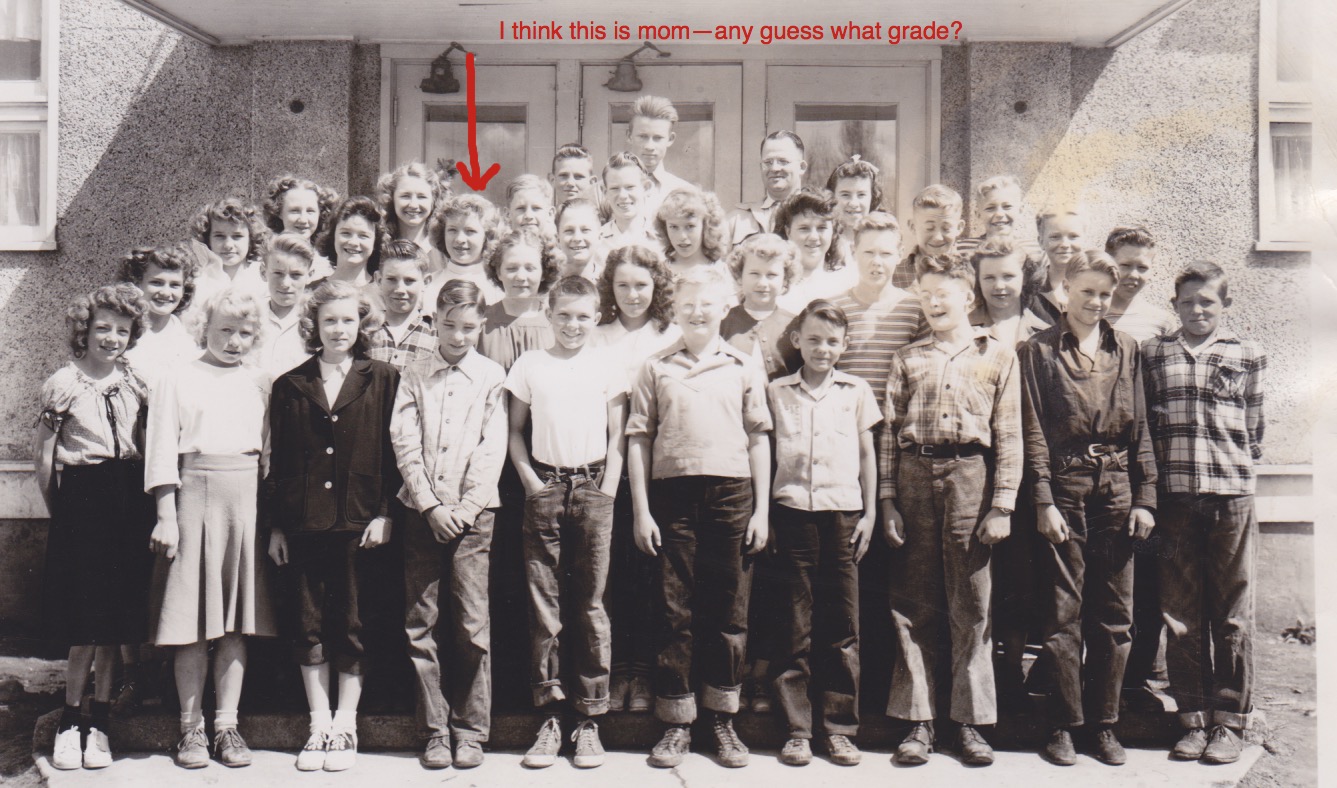
I think that the arrow points to mom, but there's no indication of the grade.  They look like they're older than 6th grade to me.  Aunt Janie thought that it was probably 7th or even 8th grade.
I can't get over the feeling that came over me as I pulled out piles of old papers and discovered all of these old photographs.  It was as if a magic quiet came over my soul.  

There was another photograph I found of mom as a bridesmaid for her best friend Jeanean Gardner's wedding.  She is sitting so still--most of my memories of mom have her in constant action:  playing the organ at church, playing the flute with me as we sit at the piano, her hands moving over the piano keys while Susan, Martha and I sang.  She bought matching rain coats and umbrellas for the three of us and taught us a dance routine for "Singing In the Rain"--a number that we did for the Ward Talent Night while we were living in Edina, MN.  (6105 Parnell Avenue, Edina MN 55424)  Mom was always moving the furniture around the house.  She was home room mother for all of us--I remember the burnt spud nut left overs that remained on the countertop after she took all the good ones for one of our class parties.  There were the chives that she brought all the way from Wyoming and planted on the side of our Minnesota home--she would go out and cut a handful to put in our breakfast scrambled eggs.  Then there were the scrambled eggs that mom made for Crook--our Siamese cat--while all of us kids had to eat oatmeal for breakfast.  I remember her rubbing a popsicle on Nathan's mumps while he slurped it down--Nate was only about a year old and she couldn't get him to keep anything cold on his neck to ease the fever and pain.  I was kind of grossed out that he would be so sticky--but the ruse worked and the fever and swelling did subside.  I still love rice baby cereal mixed with milk (though mom preferred formula with hers) for breakfast.  I also remember a night when we were sitting at the great big round table, eating "hotdog pennies" with cottage cheese for supper--while I watched through the kitchen windows as mom worked in the backyard.  Dad was gone to Georgia for work from Monday to Friday.  Mom must have been lonely--but I remember only all of the things that she did keeping the house clean.  There were evenings sitting downstairs on the cold floor while we all folded clothes that had gathered into clean mountains of colour on the folding table.  I remember the chute that dad made between floors so that we could send our dirty clothes downstairs from the upstairs bathroom.  There was also the huge blackboard on the basement wall--across from the washer and dryer.  And Thanksgiving with 30 or 40 people filling our basement--on the side with carpeting and the TV--laying around and watching TV after the huge meal.  I was sitting upstairs with mom and dad in the kitchen after a Christmas dinner with turkey and pies and whip cream--Nathan had asked for an apple before we ate and mom told him that he could have one after we ate.  While everyone was having seconds on dessert--Nathan came and asked mom if he could have an apple now.  

So many strange bits and pieces come back to me tonight.  I was talking with a doctor this morning and he asked me about mom and dad--if they were alive, in good health, etc.  I told him about dad and his work and then he asked me what mom did.  She was a mom, I told him--just what she always wanted to be.  I hadn't thought about what a unique family we had growing up--a dad who was faithful and loving--and a mom who didn't work for pay, but was happy being in our home--there when we came home from school.  

We were very lucky people.

Thursday, June 11, 2015

Just Another Wild Night

6 June 2015

This is one of the better photos I took while covering the Youth Trek activity.  It's not two escaped, French resistance fighters, but it fits the mood I'm in.


I sit here in one of our huge leather chairs, swaddled with a quilt and heated on one side by Charlie, Lauren’s small dog.  We’ve just finished watching a French film (dubbed in English) about a prisoner during WWII:  a French resistance fighter caught by the Germans while as he blew up a bridge.  It was a sad, inspiring movie: sacrifice, unjustifiable trust, slow planning, encouragement, a package from home, vermin and gruel.  It was in black and white—and very quiet.

There was a curious absence of sound:  no loud laughter, vulgar swearing, caustic threats, or self-aggrandizing yelling—no cars blown up, no wild gun fights with countless guns shooting off dozen times more ammunition than any person could possible carry.  

This intense, curious quiet drew my attention to small bits that I would usually overlook.  The silent backdrop highlighted the whispered encouragement; magnified the slight rustling of paper as notes were passed from one man to another; and made the the bird-like squeak of the German officer’s bicycle echo carefully as the men made their way across the last space on their way to freedom.

The final image is of the two escaped prisoners, the older man with his arm around the shoulders of the 16 year old boy who had joined him at the last moments of the movie.  They walk quietly, with determination, away from the audience, into the night fog.

Charlie:  reflective and relaxed.
Their tense apprehensive steps come as a sharp contrast to Charlie—asleep like a limp carrot someone left out on the counter overnight.  

My head feels like a spacious—no, cavernous—void where my brain used to be.  My lungs, in contrast, have ooze filling up the alveoli, one by one . . . and I am beginning to cough it back up by the throat-full.    

The “thuck-thuck, thuck-thuck” rhythm of the baby swing in the corner reassures me that the baby sleeping there is fed, burped, and comfortably resting . . . and not likely to cry out any time soon.

Charlie has abandoned me for the cool of the tile floor.  

There is another old movie on the television.  Back and white but a comedy about a NY reporter who uncovers a plot that will influence the start of WWII—but no one believes him.  This one has car chases and gun shots and not-so-subtile misunderstandings and Latvians.  


Another wild Saturday night at the Hendry’s.

Friday, February 27, 2015

Morning Essay

Brent and I went to New York City a few years back and he took this picture of me as we stood on the top floor of The Castle in Central Park.  The wind was wicked sharp and cold, which made my eyes water.  I know I've posted this before, but it fits how I feel right now . . . 

This morning I cannot sleep.  I got up to use the bathroom at 5:40 am--and sweet husband of mine is snoring steady, quiet rumblings and so I cannot get back to sleep.  I go into the kitchen and open the refrigerator door.  Raspberries . . . the last of the season.  There are four small, square, clear containers and I fish two of them out from the bottom produce drawer.  I immediately begin to eat, just standing there in the middle of the room.  I check each one to see if it has begun to  mold yet--that black goo that melts the berries together from the bottom up, but leaves the top with the delicious satin-deep-red landscape of healthy fruit.  I am in luck--these were fresh enough when I bought them a few days ago that they are still lovely and sweet (and ever-so-slightly prickly as if I had just picked them from my Grandma Burton's raspberry patch). 

I also swallow one of the last amoxicillin the doctor prescribed last Saturday for a run of  bronchitis that has turned out to be viral--but I still need to finish the antibiotics so that I don't harbor one of those "super bugs" that becomes immune to medicine.  The pills are white, hard-pressed ovals that stick in my throat if I don't "take with food."  I guess I am stuck with the cough and breathlessness that characterize my own brand of bronchitis for another few weeks . . . the one "going around" has a reputation for lingering about eight weeks or so before leaving.

The rabbits are restless this morning--ringing the bell that hangs from the top of their cage, chewing at the new toys I put in with them this morning.  They are currently shedding--their internal clocks pushing out old  and replacing it with a new down-like undercoat--even though they are (with rare exception) always kept inside the house where it is sixty-eight degrees.  Yesterday Nathan got Murphy out and we trimmed his nails and around his tail where he has a hard time keeping clean.  Brent also needs me to trim his hair this weekend--perhaps the rabbits are not so off-kilter as I believe.

Where was I? . . . yes . . . 6 am and raspberries.  Then, because right hamstring is still raw from a fall on Monday, I waunder into the TV/study room and slide up onto a double-pillow cushion nestled in one of the big leather side-chairs.  I look around and think about doing some more accounting ("managerial" this semester) homework because there is a test next Thursday and I still have to look at my notes to finish the practice examples correctly.  I can turn on the TV, I think, and work with the background noise to cover the loud "ta-TAK" of the kitchen clock.   And because it is a habit to have it on all the time now.  We record the few shows we like and watch them end-to-end, sometimes for hours at a stretch.  

But, instead, I look to my right and see some of the few books that I still keep on the shelf.  We have been purging the house of anything loose we find that we don't mind not keeping.  It is a beginning at downsizing . . . a VERY beginning.  There are children's books: The Cat in the Hat, Rikki-Tikki-Tavi, Princess Smartypants, The View from Saturday and a few "grown-up" books I will have a very hard time letting myself get rid of:  Beauty by Robin McKinley and Lewis Thomas' Late Night Thoughts on Listening to Mahler . . . and two by Mitch Albom:  For One More Day, and Tuesdays With Morrie.  

I am in a mellow mood, restless as sit because of the angry tendons connecting the muscles of my right back leg to the bones underneath my right bun.  I have the house to myself--Nathan is away, dog-sitting for some people while they travel--Brent is still sleeping.  I am in the mood to think deep thoughts and to cry just a little bit.

I reach over and pick out Tuesdays With Morrie.  It is a quick read and before I know it, I am into the parts where I want to remember the words and so I reach for a pen and mark the lines.  They are about how hundreds of thousands of people are glued to their TV screens, following the O. J. Simpson trial instead of living lives of their own.  (The only thing I remember about the proceedings is that several lawyers made millions and a white SUV was trailed through the freeway system by police cars with their flashing lights on.)

The point is made that none of these people know Simpson--he certainly doesn't know any of them--yet they spend their entire lives on him.  Crazy.  

I know why they did this, though, it is because personal relationships take energy, thought and time.  People can tread on our emotions and, often, our hearts--at least in the relationships that really matter.  Individuals, however, can experience emotions by watching someone else show theirs--without having to invest anything of their own.  It is much less taxing--much easier.  I do not have many close friends--in fact, my closest friends are pretty much found in my own home and within the circle of my close family.  

I think that is why Facebook and Pintrest are able to consume so many.  Look!  I have 147 "friends". Look!  More than a thousand people "like" the picture I posted yesterday--they "like" me!  They send me pigs and sheep and invite me to play "Candy Crush."  Inane, angry birds have been hurled into the toy stores and Saturday cartoons.  Lego fans make short movies out of Legos and put them up on YouTube.  The dialogue is corny and flat---and on the few I've seen are pretty much pointless.   They are well done, however, and I would much rather watch a few of those than the sitcom re-runs dredged up from the 70's and 80's.  

I think that one of the reasons Albom's book compels me so is that the main character, a college professor named Morrie, fills his life with giving.  It is almost as if the more he gives, the more he has.  When Albom describes Morrie, he recounts the classes he took, the conversations they had, a 50 page Senior thesis Morrie helped him write.  There are no material gifts--what I throw at people instead of offering time and a listening ear.  

I yearn to leave something behind me that will mean that I have left a mark--a good change--on this Earth.  When the Earth is burned to purify it for Christ's coming, I want Heavenly Father to sigh for just a second before burning a spot that I have made better than it would have otherwise been.  

Perhaps our yard will be that spot.  Over the last ten years, Brent has allowed me to spend thousands of dollars on worker hours, soil, fertilizer, mulch (oh, so much mulch) and countless plants and trees.  Many of the plants have come from seedlings or cuttings that I started.  It is a source of satisfaction for me that this is so.  I trim back the hedge that follows the back and side walkways knowing that I stuck bits of twigs in the ground--and they grew!  

Morrie also talks about emotions--especially ones usually considered negative:  self-pity, helplessness, hopelessness, depression, sorrow, grief.  He says that he has to let himself experience them, recognize them, and then let them go so that he can continue on to fill his day with love and friendship and wisdom.   

I know that I have done this with pain.  I know how it feels, how my soul cringes from it, how it hangs over my mind and clouds my vision.  When I experience it, though, it is getting easier to deal with.  I no longer wallow in it--but am able to know it and then look through it to the people and tasks that face me.  Grief, guilt--I know them, but still have a hard time facing them, embracing them, and then leaving them so that I can go on with the things I want to do.

Brent is up now and Valley cat is meowing to be let back in from being outside on the porch (It's raining steadily--no birds or lizards to watch through the screen.).

In the Book of Mormon, I'm in 3rd Nephi--just after Christ has been crucified and there have been three days of black, suffocating grief as the Earth mourned the death of Her Creator.  Whole cities buried under mountains, swallowed by the sea, burned by fire--and then His voice chiding the "least wicked" because He sent His prophets to teach them, to prepare them--and they killed them.  At the end of the chapter, though, He welcomes them to come to Him and repent "for my arms are reached out still."  How can a planet know Her Creator is being killed?  What is there in the soil that calls out because it has been soaked by the blood of the righteous?  And how can an Earth now accept us and prosper us?  

My Lauren half-jokes, half-laments that her "Mom can put a stick in the ground and it grows!" while the herbs outside her front door wither away and die.  She has gotten an orchid to bloom, though--which is a very rare occurrence at my house.  I think we all have our own strengths.

It is after 9 am now and I am fully awake.  Papers to get notarized, Visiting Teaching to make a stab at, more stuff to go through and get rid of, homework . . . 


. . . and still a few more raspberries to enjoy.